
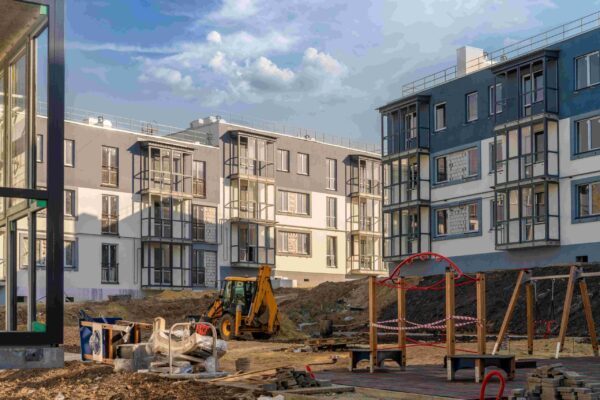
Brady Square was initially viewed as a crucial component of the city’s affordable housing policy. In South Richmond, where problems with abandoned neighborhoods and low investment had been accumulating, there were plans to build a modern residential complex on 14 acres of land between Brady Street and Lynhaven Avenue.
The project included 264 one-, two-, and three-bedroom apartments, as well as a community center that would become a new attraction for neighbors. The main idea was to make housing affordable for families with incomes at 30%, 50%, and 60% of the city’s median income. In 2020, the median income in Richmond was about $51,000, meaning Brady Square could have been a lifeline for hundreds of households.
Start of construction
 From the outset, it was clear that the project would not get off the ground without a mix of financing. Private investors, including Boston Financial and Chase, as well as government agencies, contributed to the project. Richmond allocated $1.2 million for the first phase, and Virginia Housing issued $12.1 million in loans. The total cost was estimated at $55 million. An impressive sum for the South Richmond area.
The start of construction in 2022 was seen as a victory. Bulldozers arrived on site, workers poured the foundation, and many residents felt that the neighborhood was changing before their eyes. In the early stages, Dakota Partners was actively involved in the construction, and expectations were high. But a year later, everything came to a standstill.
At the end of 2023, contractors began complaining that their bills were not being paid. Some left the construction site, leaving materials behind, while others filed lawsuits.
The site became empty, and only the fence reminded us that life had been bustling here not long ago.
Problems on the site
According to The Richmonder, in December 2024, the situation reached the City Council. Chief Administrative Officer Lincoln Saunders stated bluntly that the city would not provide any new funding until previous commitments were fulfilled. The council voted to withdraw the planned $500,000 in support.
Councilwoman Rewa Trammell called it a disaster and added that the vacant buildings had become a symbol of unfulfilled promises for over a year. For contractors, this resulted in losses of hundreds of thousands of dollars. For example, the owner of Whaley Excavating said that Dakota Partners owes him about $800,000 for materials and labor.
Local residents are also expressing disappointment: half of the complex stands idle, and rumors and concerns are swirling around the empty buildings.
What is known at this point?
- Dozens of unfinished houses stand behind black plastic fencing on the site.
- Contractors have filed lawsuits and mechanic’s liens in an attempt to recover their money.
- Private security guards are on duty at the site, but there are no workers there.
- The city is willing to consider assistance if the project is transferred to a new developer.
This situation clearly illustrates how easily bureaucracy, financial difficulties, and a loss of trust can hinder ambitious plans.
Context
Dakota Partners is no stranger to affordable housing. The company has more than a dozen projects in New England and over 1,400 apartments. However, after the pandemic, construction materials rose sharply in price, and logistics failed.
In July 2024, Dakota even abandoned a 98-unit project in Concord, explaining that the estimates made construction financially impossible. Such decisions seem pragmatic for business, but for a city like Richmond, this becomes a serious problem.
Context is also essential. In recent years, Richmond has been actively discussing the construction of affordable housing. Officials emphasize that the city needs at least 40,000 new housing units to meet demand. Against this backdrop, the failure of Brady Square looks particularly painful, as the project could have at least partially closed the gap.
Prospects for the project
Today, the fate of Brady Square depends on creditors and whether a new developer will emerge who is willing to see the project through to completion. City officials have not ruled out support, but only if the situation changes and the project team is different.
The story of Brady Square has been a lesson for Richmond. It serves as a reminder that even the most ambitious projects can be halted by a chain of problems, ranging from rising prices to litigation. However, at the same time, it presents an opportunity for the city to reassess its approach to supporting developers and selecting partners.
Brady Square is both a source of hope and a warning. The hope is that the project will still be completed, and hundreds of families will receive housing. The warning is that any promises must be backed up not only by beautiful plans, but also by a reliable organization.